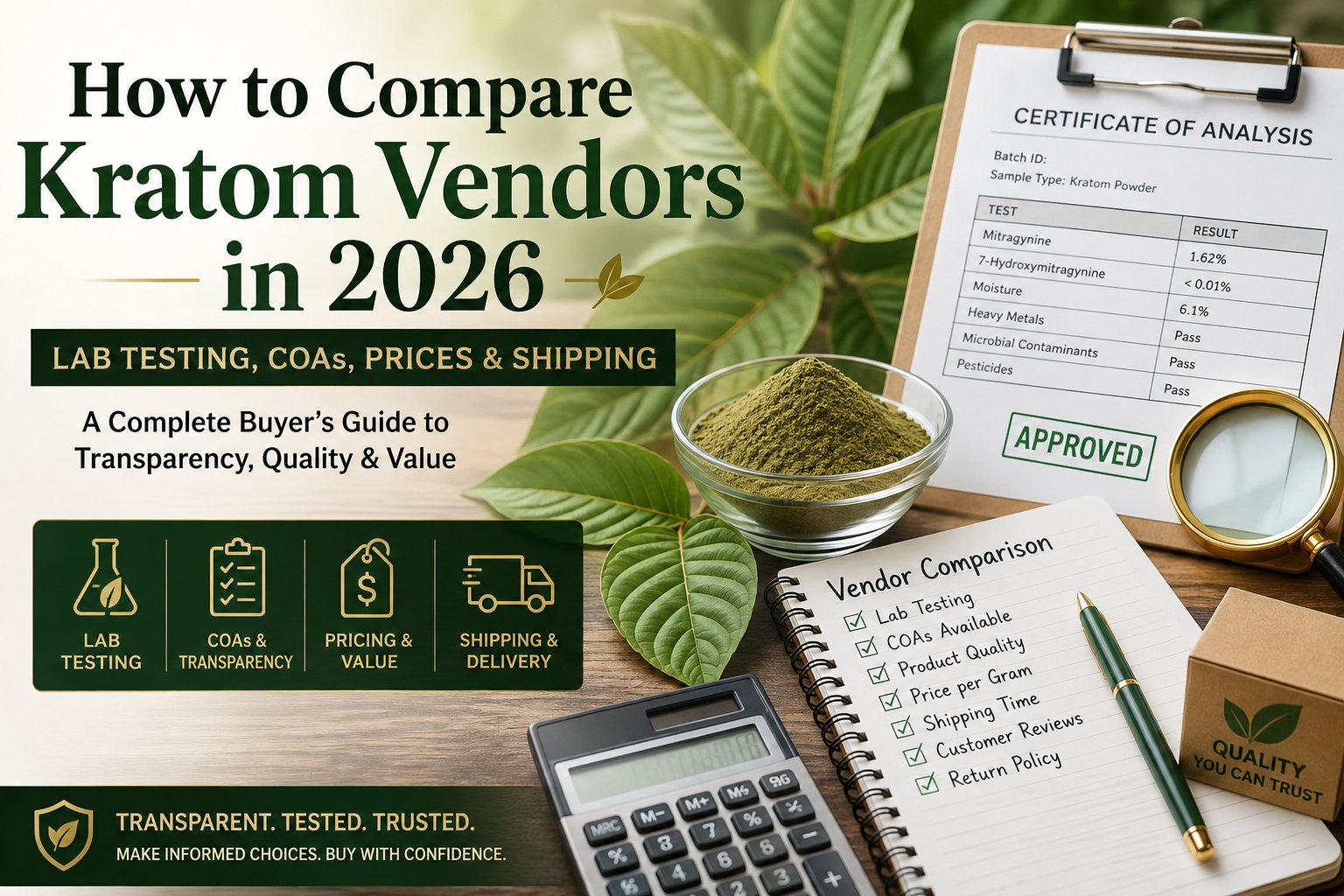
How to Compare Kratom Vendors in 2026: Lab Testing, COAs, Prices & Shipping
Buying kratom online in 2026 gives consumers more choices than ever, but having more vendors to choose from does not necessarily make the buying decision easier.
Two websites may sell products with similar names and prices while differing considerably in laboratory testing, batch documentation, sourcing transparency, shipping policies and customer support.
That is why comparing kratom vendors should involve more than simply finding the lowest advertised price.
A stronger approach is to examine the evidence behind the product.
Here are the most important factors buyers can check before choosing an online kratom vendor.
1. Start With Third-Party Laboratory Testing
Laboratory testing should be one of the first things examined when comparing kratom vendors.
Responsible vendors may test products for several characteristics, including alkaloid content and potential contaminants.
Depending on the laboratory and testing program, reports may include screening for:
Mitragynine
7-hydroxymitragynine
Heavy metals
Microbial contaminants
Salmonella
E. coli
Yeast and mold
However, simply seeing the phrase “lab tested” on a website does not provide much information by itself.
The important question is whether the vendor provides documentation supporting that statement.
This is where the Certificate of Analysis becomes useful.
2. Check Whether the Vendor Provides a COA
A Certificate of Analysis, commonly called a COA, is a laboratory document reporting the results obtained from testing a sample.
When reviewing a kratom COA, look beyond whether the document says that the sample passed.
A useful report should provide enough information to understand what was actually tested.
Look for details such as:
Batch or lot number
The report should ideally correspond with an identifiable production batch.
Testing date
A recent report is generally more informative than an undated document or a report several years old.
Laboratory identification
Consumers should be able to determine which laboratory conducted the analysis.
Sample identification
The product described in the report should reasonably correspond with the product being sold.
Test results
Rather than vague claims, the report should contain actual analytical results or clearly stated testing outcomes.
A beautifully designed COA means little if it cannot be connected to the product being offered.
3. Look for Batch-Specific Testing
One of the strongest signs of laboratory transparency is the ability to connect testing documentation with a particular batch.
Botanical products can naturally vary between harvests and production runs.
Therefore, a single laboratory report should not automatically be assumed to represent every product a vendor has ever sold.
When comparing vendors, ask:
Does the product have a batch or lot number?
Can that number be connected with laboratory documentation?
How recently was the batch tested?
Does the report identify the product clearly?
The easier a company makes this verification process, the more useful its testing program becomes to consumers.
4. Evaluate Vendor Transparency Beyond the Laboratory Report
Laboratory documentation is important, but it is only one part of vendor transparency.
A trustworthy-looking website is not evidence by itself.
Look for concrete information.
For example, consumers may want to check whether the company clearly publishes:
Contact information
Shipping policies
Return or refund policies
Product information
Laboratory documentation
Batch information
Terms and conditions
Privacy policies
Customer-service channels
Transparency means a consumer can understand who they are buying from and what policies apply before completing the purchase.
If important information is difficult to locate, that should become part of the comparison.
5. Compare Kratom Prices Using the True Cost
Price comparisons can be misleading.
Suppose Vendor A sells a product for $29.99 while Vendor B sells what appears to be the same amount for $34.99.
Vendor A initially appears cheaper.
But then shipping is added.
Vendor A:
Product: $29.99
Shipping: $9.95
Total: $39.94
Vendor B:
Product: $34.99
Shipping: Free
Total: $34.99
Vendor B is actually cheaper at checkout.
This is why buyers should compare the delivered price, not merely the product price displayed on a category page.
6. Calculate Price Per Gram
Package sizes can also make price comparisons difficult.
One vendor might sell 100 grams, another 125 grams and another 250 grams.
A simple price-per-gram calculation makes comparisons easier.
For example:
$24.00 ÷ 100 grams = $0.24 per gram
$49.00 ÷ 250 grams = $0.196 per gram
The second package costs more overall but provides a lower cost per gram.
This approach becomes particularly useful when comparing bulk sizes.
However, price should still be considered alongside testing, documentation and vendor transparency.
The cheapest product is not automatically the best value.
7. Examine Shipping Before Ordering
Shipping is another area where apparently similar vendors can differ considerably.
Before purchasing, check:
Processing time
How long does the company say it takes to prepare an order?
Available shipping methods
Does the vendor provide standard, expedited or priority options?
Shipping charges
Is shipping included, flat-rate or calculated according to the order?
Tracking
Does the customer receive shipment tracking?
Free-shipping threshold
Some vendors provide free shipping after the order reaches a certain amount.
A vendor advertising fast shipping may still have a separate processing period before the carrier receives the package.
For this reason, distinguish between processing time and carrier transit time.
8. Look at the Vendor's Overall Product Information
Product pages themselves can reveal a great deal about a vendor.
Strong product pages generally provide useful information rather than relying entirely on promotional language.
Look for clear descriptions of:
Product format
Package size
Batch information where available
Testing documentation
Storage information
Shipping details
Relevant policies
Be cautious when product descriptions rely heavily on dramatic promises while providing very little verifiable information.
Documentation is generally more useful than marketing language.
9. Check Whether Claims Can Be Verified
A useful principle for comparing kratom vendors is:
Separate claims from evidence.
A vendor might say:
“Premium quality.”
“Laboratory tested.”
“Highest quality.”
“Best kratom.”
Those are claims.
Evidence would include things such as laboratory reports, batch identifiers, clearly stated policies and verifiable company information.
Whenever possible, compare vendors using information you can actually inspect.
10. Watch for Common Red Flags
No single issue automatically proves that a vendor is unreliable, but several warning signs together deserve additional scrutiny.
Potential red flags include:
No accessible laboratory documentation
COAs without identifiable dates
Laboratory reports unrelated to identifiable batches
Missing contact information
Unclear shipping policies
Confusing refund policies
Extremely aggressive marketing claims
Prices dramatically below comparable sellers without explanation
Product information that appears copied or generic
The goal is not to find a vendor with the fanciest website.
The goal is to find one that makes important purchasing information easy to verify.
11. Use a Simple Vendor Comparison Scorecard
Instead of opening several vendor websites and trying to remember everything, create a small comparison table.
Comparison Factor | Vendor A | Vendor B | Vendor C |
|---|---|---|---|
Third-party testing | ✓ / ✗ | ✓ / ✗ | ✓ / ✗ |
COA available | ✓ / ✗ | ✓ / ✗ | ✓ / ✗ |
Batch identifiable | ✓ / ✗ | ✓ / ✗ | ✓ / ✗ |
Testing date shown | ✓ / ✗ | ✓ / ✗ | ✓ / ✗ |
Clear sourcing information | ✓ / ✗ | ✓ / ✗ | ✓ / ✗ |
Price per gram | ___ | ___ | ___ |
Shipping cost | ___ | ___ | ___ |
Processing time | ___ | ___ | ___ |
Return policy | ✓ / ✗ | ✓ / ✗ | ✓ / ✗ |
Customer support | ✓ / ✗ | ✓ / ✗ | ✓ / ✗ |
This immediately changes the buying decision from:
“Which vendor looks best?”
to:
“Which vendor provides the strongest combination of documentation, transparency, price and service?”
That is a much better question.
12. Don't Let Discounts Override the Basic Checks
Discount codes and promotions can certainly affect the final price.
But they should come after evaluating the vendor.
A 20% discount on a poorly documented product does not suddenly make that product well documented.
A sensible sequence is:
Verify → Compare → Calculate → Buy
First examine the vendor.
Then compare products and documentation.
Then calculate the actual delivered cost.
Only afterward should discounts become part of the decision.
13. What Makes a Strong Kratom Vendor Comparison?
A useful vendor comparison should consider several factors together rather than declaring a winner based on one metric.
The strongest overall evaluation generally examines:
Laboratory transparency — Can you inspect meaningful testing documentation?
Batch traceability — Can testing be connected with identifiable products or batches?
Vendor transparency — Are company information and policies easy to locate?
Pricing — What is the real cost per gram and delivered cost?
Shipping — Are processing times, shipping methods and charges clearly explained?
Customer support — Is there an obvious way to contact the company if something goes wrong?
A vendor does not necessarily need to be cheapest in every category.
What matters is the overall combination.
Final Thoughts
Comparing kratom vendors in 2026 should not be reduced to finding whichever website advertises the lowest price.
Consumers now have access to considerably more information than that.
Laboratory reports, Certificates of Analysis, batch numbers, shipping policies, pricing structures and vendor disclosures can all be examined before making a purchase.
The best comparison process therefore starts with evidence.
Check the COA.
Check the batch.
Calculate the real price.
Read the shipping policy.
Review the vendor's transparency.
Then compare the complete picture.